


Design Brief
To design and evaluate an interactive electro-tactile experience that uses touch as a medium for emotional expression and communication, while creating a meaningful, comfortable, and engaging user experience.
Meet the Team
My Contributions
-
Conducted research on electro-tactile feedback, anxiety regulation, and tactile interaction.
-
Developed concepts, user journeys, and interaction scenarios.
-
Designed and modelled the product in Rhino through multiple iterations.
-
Created and tested 3D-printed prototypes and tactile button variations.
-
Contributed to coding, debugging, and testing electro-tactile interactions.
-
Produced renders, exploded views, and presentation materials.
-
Conducted user testing and refined the design based on feedback.
-
Contributed to branding, visual identity, and final project documentation.

Shannon Mohr
Technical Designer &
Prototype Specialist

Charlotte Munday
Interaction Architect

Amy Lee
Communication &
Experience Designer

Kelly Caviedi
Experience Strategy
Designer
ELECTRODE SENSOR
POWER BUTTON
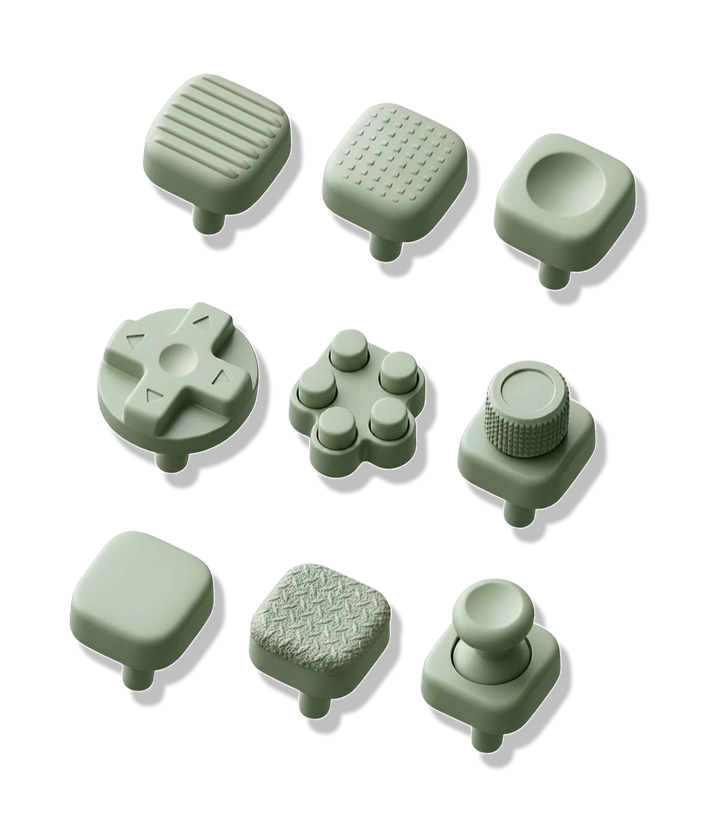
FIDGET KEYCAPS
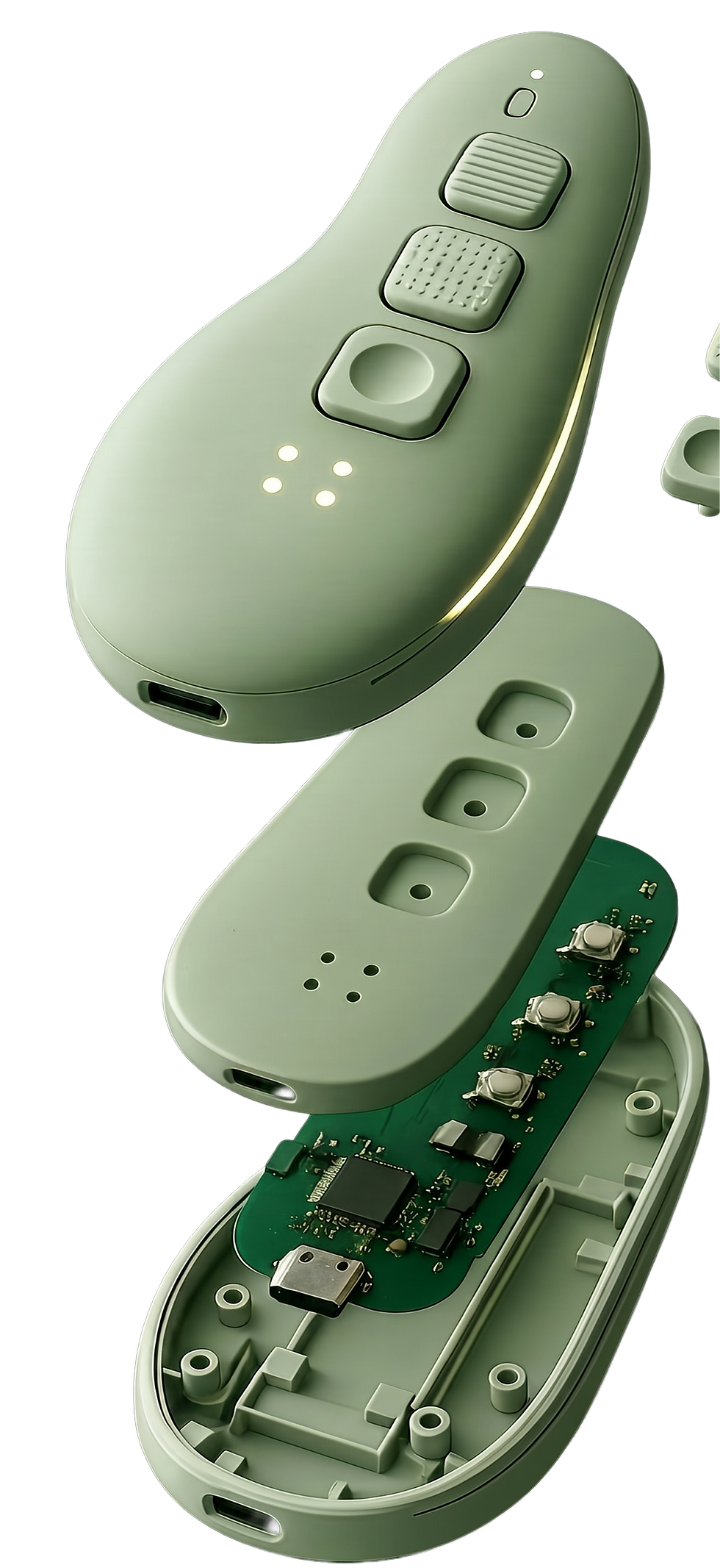
CUSTOMIZABLE FIDGET KEYCAPS
ETACTILEKIT (CIRCUIT BOARD)
USB-C PORT
Problem Space
Background Research
In HCI, electro-tactile (ET) interfaces offer unique advantages: fast, localised tactile response delivered through thin, flexible form factors. Yet their hardware complexity has historically limited who can design with them. The eTactileKit (Perera et al., 2025) removes that barrier, providing an accessible, end-to-end toolkit for designing, simulating, and prototyping ET experiences.
Anxiety disorders are the world's most common mental health condition, affecting 359 million people globally (WHO, 2025) — with onset most frequently during youth. Our project applies the kit’s capabilities to that gap: exploring how programmable pulses, rhythms, patterns can be embedded into an everyday artefact to help young adults recognise and regulate their emotional state.
Touch is a highly effective channel for emotional regulation. Ugurlu & Keltner (2026) demonstrate that tactile contact facilitates emotion regulation through neurophysiological pathways.
Haptic stimulation carries significant potential for shifting emotional and attentional states. Wearable haptic vibration enhances brain activity and emotion recognition (Wang et al., 2023), while rhythmic pressure on the body can directly influence breathing rate and perception of calmness (Papadopoulou et al., 2019).
Electrotactile perception is highly individual and context-sensitive. The variables include sensation intensity due electrode-to-skin impedance, affected by sweating and pressure -- alongside wave type, stimulation location, electrode type (single/array); broader factors like gender, hand dominance (Yang et al., 2022).
Reframing the Problem
Our initial brief asked how ET feedback could support emotional regulation. However, research showed a gap between “stress relief products” and truly responsive, behaviour-aware regulation tools within the growing trend of wellbeing design.
From designing a calming intervention → To designing an adaptive tactile habit
How might we design adaptive electro-tactile fidget interactions that help users regulate anxiety and feel more grounded in everyday life?
Primary Research
Following a triangulated research, we found...
Participants' existing coping strategies skewed heavily tactile with 72% survey responders reporting habitual fidgeting during stress. Majority also turn to exercising or using meditation apps for distraction.
44% were open to a dedicated device and 16% refused outright. 40% who were uncertain suggested that the real barrier might be infamiliarity with the sensation and its practicality for daily use.
The physical sensations most associated with calm are rhythmic / pulsing and soft / subtle, with a preference for the device to be discreet as anxiety / panic can set in publicly.
Tactile perception thresholds vary by age, gender, and stimulation parameters, meaning calibration and personalisation are not optional refinements but prerequisites for effective ET design.




Prototype 1: The Clicker


A 3D-printed dome-shaped fidget with a 3cm clickable button and side-mounted electrode, effectively combining physical fidget and ET feedback.

Prototype 2: The Clippy
A clip-based form designed to sit between the thumb and index finger. An electrode was positioned on the top surface for the index finger, alongside tactile buttons with varying textures for others.
Prototype 3: The Graspy
A rectangular handheld device featuring four interchangeable keycap buttons designed to support customisable and removable fidget interactions.

Prototype 4: The Grippy
A grip tool made with clay and 3D modelling to achieve a natural fit in the hand and improved grip comfort.
Why Women?


Show product size
Why Women?

Average Women Hand Length: 17.0–18.0 cm
Average Women Hand Breadth: 7.0–8.5 cm

Show product size


Product Length: 17.3 cm
Hand Breadth: 7.9 cm

The
CLICKER
RATIONALE
FEEDBACK
- 3D printed dome shaped handheld fidget device exploring anxiety reduction through tactile interaction.
-
Included a clickable 3cm button and side mounted electrode to combine fidget and electro tactile feedback.
-
Designed to explore satisfying physical interaction and handheld comfort.
-
Audible click was distracting and drew unwanted attention.
-
Interaction felt engaging but not aligned with a discreet calming experience.
-
Electrode placement near the thumb was less effective in producing sensation.
- Led to further focus on ergonomics, finger placement, and subtle interaction.
RATIONALE
-
Clip based design positioned between thumb and index finger.
-
Included electrode placement on top with multiple textured tactile buttons.
-
Shifted focus from fidgeting toward electro tactile interaction and natural grip behaviour.
-
Explored ergonomics, silicone materials, and hyperhidrosis considerations.
The
CLIPPY

FEEDBACK
-
Clip mechanism felt uncomfortable and restrictive.
-
Users preferred holding the device rather than attaching it.
-
Hybrid materiality highlighted need for softer, more comfortable surfaces.
- Finger placement proved highly individual, requiring more adaptable design.

The
GRASPY
RATIONALE
FEEDBACK
-
Rectangular handheld device with interchangeable keycap buttons.
-
Integrated fidget and electro tactile feedback into a unified system.
-
Inspired by mechanical keyboards and fidget device trends.
-
Rubber ridged sides added for improved grip and control.
-
Explored both 4 key (cardboard) and 3 key (clay) configurations.
-
Helped refine ergonomics, spacing, and tactile variation.
-
Supported increased user control and personalization.
- Required further refinement of layout and feedback consistency.
RATIONALE
FEEDBACK
-
Pear shaped handheld device developed through clay and 3D modelling.
-
Designed for natural hand fit and improved grip comfort.
-
Dimensions informed by average hand size of target user group.
-
Focused on subtle interaction and combined haptic-fidget experience.
-
Improve materiality with softer, sweat resistant surfaces.
-
Introduce detachable hand strap for stability.
-
Expand interchangeable keycap system with varied tactile responses.
- Integrate multi-point electro tactile feedback across multiple keys.
The
GRIPPY


Technical Skills Applied
Software
-
Python
-
VS Code
-
eTactileKit SDK
-
GitHub
Hardware
-
Electro-tactile electrodes
-
TactileKit controller module
-
Flexible printed circuits
-
Custom fabricated prototypes
Design
-
Rapid prototyping
-
Interaction design
-
User-centred design
-
Experience testing
-
Iterative development
1.
Python Development
Create stimulation patterns and control logic.

From Code to Touch
Using Python, custom electrode design, and rapid prototyping, I developed an electro-tactile system that transforms digital stimulation patterns into physical sensations. Through iterative testing and hardware integration, I explored how touch can become a meaningful interaction medium for emotional regulation and sensory experiences.
4.
Final Prototype
Combined software, electronics, and physical prototyping into a fully functional electro-tactile device.

2.
Electrode and Hardware Integration
Create stimulation patterns and control logic.

3.
User testing
Test with users, iterate on patterns and refined tactile experience.


Final Product


