top of page


Step by Step is a sequence of interactive hopscotch lanes embedded along The Goods Line. The experience begins with a short, easy interaction and gradually increases in length and complexity as people move forward through the site.
Participants can choose to:
Play a single lane as a moment of pause
Or continue walking and playing through multiple lanes
Each interaction contributes to an accumulating score. At the end of the path, users can scan a QR code to view and share their result, extending the experience beyond the physical space.
The concept combines:
Movement through walking
Progression through increasing challenge
Place-based play tied to the Goods Line
A digital layer that does not interrupt physical interaction
Core Concept
The installation is designed as a modular system, where each hopscotch lane functions independently.
Each lane includes:
Pressure sensors to detect footsteps
A microcontroller (Arduino / ESP32)
LED lighting embedded beneath the surface for feedback
Optional sound feedback can be included, though the system is designed to function silently for subtle, public-space-appropriate interaction.
This modular approach allows:
Prototyping of one or two lanes
Conceptual scaling to many lanes across the site
Physical & Technical Setup
Option 1: Anonymous Progressive Play
Scores accumulate automatically as users move forward. Each lane displays a prompt encouraging continuation, and the final lane invites users to scan a QR code to save or share their score.
This approach:
Requires no phone during play
Works naturally in public space
Minimises friction
Option 2: Session-Based Play
Participants start by scanning a QR code or tapping an NFC point to begin a session. Scores are then linked across lanes using a temporary session ID.
This option enables richer data and leaderboard features but adds technical complexity.
Accumulating Scores Across Lanes
Discovery → Participants notice illuminated hopscotch tiles ahead
First Interaction → A short, low-commitment play moment
Progression → Each lane becomes longer or more complex
Reward → A final scan turns movement into a shareable result
Reflection → The pathway itself becomes a game
Interaction Flow
Each hopscotch lane tracks:
Correct steps
Time to complete
Missed steps
A simple scoring system ensures clarity and motivation, with each lane contributing to an overall score. Each module records its lane ID and score, allowing results to carry forward as participants continue.
Scoring Logic
At the end of the experience, users can scan a QR code to access a simple mobile web page showing:
Their total score
How many hopscotches they completed
Optional leaderboard placement
Shareable visuals or badges
This digital layer is designed as a lightweight web experience and is presented as a conceptual extension rather than a fully built system.
QR Scan & Sharing
This project demonstrates:
Embodied, movement-based interaction
Play integrated into public infrastructure
A modular, scalable system
A clear narrative from entry to reward
A low barrier to participation with meaningful engagement
Step by Step positions interaction design as part of the city’s everyday rhythm, transforming a pedestrian corridor into a playful, shared experience rather than a standalone object.
Why This Works
Step by Step: A Vivid Instalation
Follow the Line was created as part of a brief to design a Sydney Vivid–style interactive installation that encourages public play after dark. The project required exploring multiple Sydney suburbs to identify a site that balanced accessibility, scale, and social energy. The final design prioritises playful, embodied interaction inviting passersby to move, hop, and progress through light-based prompts that respond directly to their footsteps along The Goods Line.


Why Haymarket & The Goods Line
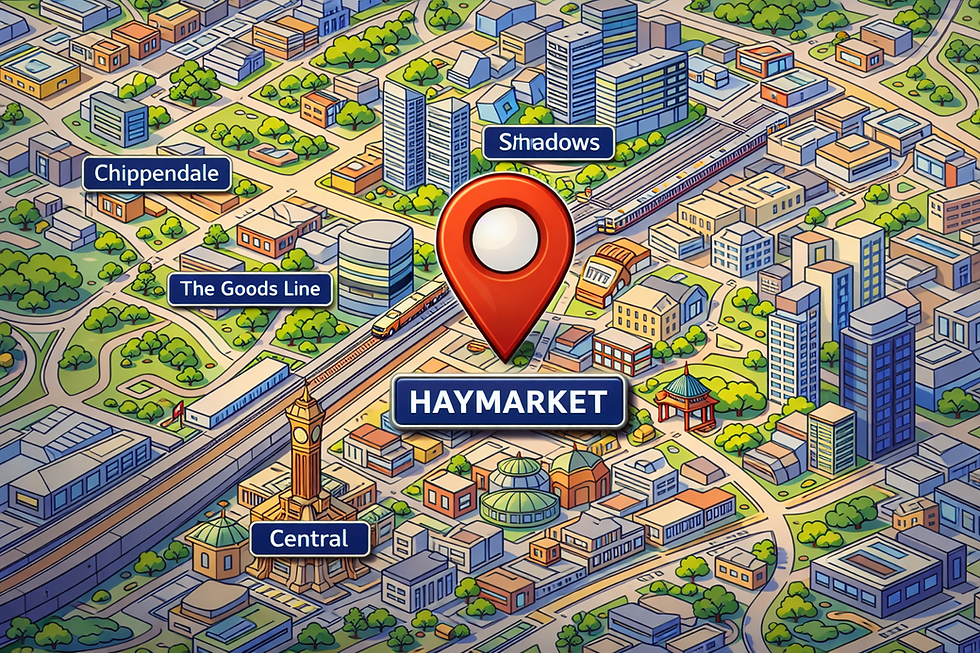
Haymarket was chosen as the starting point for this project due to its high density, cultural mix, and constant movement. It is a place where locals, students, commuters, and visitors naturally overlap, creating a dynamic public atmosphere shaped by walking, waiting, and passing through. Observing Haymarket revealed how often people navigate the city on foot without pausing moving efficiently rather than playfully.


The Concept
Step by Step is a playful public installation that transforms walking along the Goods Line into an interactive experience. Using light-based feedback that responds directly to footsteps, the project integrates seamlessly into the path itself, allowing people to engage without instructions. Short, simple interactions gradually progress into longer, more challenging sequences, supporting both quick moments of play and extended participation. Designed for a festival context, the installation encourages shared engagement, inviting individuals, groups, and spectators to experience the space together.
Playful by Design
Step by Step is built around the idea that play should feel effortless. The installation invites participation through light and movement rather than instructions, allowing people of all ages to join in instinctively. By starting with short, simple interactions, the experience lowers the barrier to entry and encourages spontaneous engagement.
Walking as
Interaction
Rather than asking people to stop, Step by Step integrates directly into the act of walking. The installation responds to footsteps, transforming an everyday journey along the Goods Line into a playful sequence of actions. Movement becomes the interface, and the path itself becomes the game.
Progression
Through Space
Each hopscotch lane functions as a small “level,” growing longer and more challenging as participants move forward. This spatial progression mirrors the physical length of the Goods Line, rewarding curiosity and persistence while allowing users to engage for as little or as long as they choose.
Shared Urban
Experience
Designed for a public festival context, Step by Step supports both individual play and social interaction. Spectators can watch, friends can compare scores, and strangers can play side by side. By turning a public pathway into a collective game space, the installation creates moments of connection within the city.
Problem Statement
Many public pedestrian spaces in Sydney are designed primarily for efficient movement rather than engagement. As a result, people often pass through these environments without interacting with them or with each other. In festival contexts such as Sydney Vivid, there is an opportunity to temporarily reimagine these everyday pathways as sites for playful interaction, while still respecting their role as active thoroughfares.
The challenge was to introduce play into a busy urban space without interrupting flow, requiring instructions, or excluding people who are simply passing through.
Possible Solution
Step by Step proposes a light-based interactive installation embedded directly into the Goods Line pathway. By responding to footsteps, the installation transforms walking into a simple, playful interaction that can be experienced momentarily or over a longer distance. Short, accessible interactions invite participation, while gradual progression along the path supports continued engagement.
Designed for a festival setting, the solution allows play to coexist with everyday movement creating moments of shared experience without demanding attention, time, or prior knowledge from participants.
Target Audience
Step by Step is designed for a broad public audience typical of a Sydney Vivid–style festival. This includes pedestrians already using the Goods Line—such as students, local residents, commuters, and visitors—who may encounter the installation while moving through the space.
The installation does not target a specific age group or skill level. Instead, it supports:
Passersby who engage briefly
Groups and friends who choose to play together
Spectators who observe before participating
This inclusive approach ensures the experience remains accessible, intuitive, and welcoming within a busy urban environment.
Approach
The design approach focused on embedding interaction into everyday movement rather than introducing a separate destination or activity. Walking was treated as the primary input, with light used as the main form of feedback.
Key considerations included:
Minimising disruption to pedestrian flow
Avoiding instructions or required setup
Supporting both short and extended engagement
Designing for visibility and use after dark
By using modular, ground-based interactions that respond directly to footsteps, Step by Step introduces play in a way that feels natural to the site and adaptable to a festival context.
Design Thinking Process
Step by Step is a playful public installation that transforms walking along the Goods Line into an interactive experience. Using light-based feedback that responds directly to footsteps, the project integrates seamlessly into the path itself, allowing people to engage without instructions. Short, simple interactions gradually progress into longer, more challenging sequences, supporting both quick moments of play and extended participation. Designed for a festival context, the installation encourages shared engagement, inviting individuals, groups, and spectators to experience the space together.
Emphatize
Observed how people move through Haymarket and the Goods Line at night, focusing on pedestrian flow, pauses, and informal behaviours in public space.
Define
Identified a lack of playful interaction in pedestrian pathways designed primarily for efficient movement.
Ideate
Explored ways to embed interaction into the ground using light and movement, prioritising intuitive and low-barrier engagement.
Design
Developed Step by Step as a modular, light-based installation that responds to footsteps and progresses along the Goods Line.
Test
Reviewed the concept through sketches and walkthroughs to assess clarity, flow, and suitability for a festival context.
Timeline
1st
Week
2nd
Week
3rd
Week
4th
Week
5th
Week
6th
Week
7th
Week
8th
Week
9th
Week
10th
Week
11th
Week
12th
Week
UX Design
Strategy &
Research (UX)
Paper
Wireframes (UI)
Usability Testing
& Refinement
(UI)
Visual Design &
Prototyping (UI)
User Research (UX)
Define Phase (UX)
Analysis & Structure (UX)
UI Design
Research Phase
Designing
Design development focused on embedding interaction directly into the ground plane. Concepts were iterated through sketches and diagrams to explore progression, spacing, and how light could guide interaction without instructions. The design prioritised modularity to support scalability and adaptability across the site.
Prototyping

Early prototyping explored pressure-based input and light feedback inspired by interactive hopscotch systems. Low-fidelity tests and conceptual prototypes were used to evaluate responsiveness, clarity of interaction, and how the installation could support both brief engagement and continued participation.
1) Prototype Setup
We created a simplified hopscotch “lane” using a small set of tiles with:
A durable surface mock-up to represent the final tile format
Embedded pressure input (or simulated pressure input)
LED feedback to indicate activation and progression The prototype was intentionally minimal so we could focus on interaction clarity rather than aesthetics.
2) Testing Method (Think-Aloud / Talk-Out-Loud)
Students were invited one at a time (or in small groups) to interact with the prototype. They were asked to use a think-aloud method, meaning they verbalised what they thought was happening while they explored it. Prompts included:
“What do you think this is?”
“What do you think you’re supposed to do next?”
“What would you expect to happen when you step here?” We avoided over-explaining so we could see whether the interaction communicated itself naturally.
3) What We Observed
During testing, we recorded:
Where users stepped first (and whether they hesitated)
Whether they understood the tiles were responsive
How they interpreted light cues (success, error, next step)
Whether they continued forward or stopped after one interaction
Social behaviour (watching others first, copying, laughing, retrying)
4) Key Insights & Design Changes
Testing showed that students quickly understood the tiles were interactive once they saw immediate light feedback. However, hesitation appeared when progression wasn’t clear—some users paused waiting for a prompt, or repeated steps to “check” what triggered the lights. Based on this, we refined the concept by:
Strengthening “next step” light cues (clearer sequencing)
Adjusting timing so feedback felt responsive rather than delayed
Considering spacing and tile grouping to better match natural stepping patterns These changes improved clarity without adding instructions, which is important for a public festival context.
5) Why This Matters for the Final Installation
This testing process helped confirm that light can act as the interface, and that the installation can support both quick, low-commitment play and longer engagement. Student testing also helped validate the idea of modular lanes and progressive difficulty as a way to encourage participation along the Goods Line.
How It Works
The installation combines material design, sensing, and light feedback to respond directly to movement.
Measurements
24”x24” and 1” tall
Pressure Sensor
Embedded pressure sensors detect footfall and trigger the interaction, allowing the system to respond directly to movement without requiring additional input.
LED Lights
Integrated LED lights provide immediate visual feedback to signal interaction and guide progression.
Texture & Material
Each tile uses a durable, weather-resistant surface with a subtle textured finish to provide grip and ensure safe use in outdoor public environments.
User Personas
Personas were developed to represent key campus coffee users and their behaviours, motivations, and barriers to using reusable cups. These personas helped ground design decisions in real user needs and daily routines.
User Persona
Ivy Lin
Lachlan Reed
Personality
Personality
Breif Story
Breif Story
Age
Age
Education
Education
Status
Status
Occupation
Occupation
Location
Location
27
40
UTS
NSW
Taken
Single
Grad Student
Accountant
Sydney
Sydney
Goals
Goals
Find vibrant yet comfortable spaces to socialise, study, or unwind
Feel secure and included when visiting Haymarket, day or night
Efficiency, reduce wasted time in commuting and daily routines.
Career Advancement
Work-Life Balance
Frustations
Frustations
Lack of public seating in Haymarket
Everything closes so early
General lack of safety at night
Long daily commutes through the Devonshire Tunnel feel tiring and monotonous
Commute Stress
Work-Life Balance
Local Amenities
Professional Pressure
Needs
Needs
Safety & Comfort: Needs public spaces that feel well-lit, welcoming, and safe to use at night.
Belonging: Wants to feel culturally included and emotionally connected to Haymarket, not just pass through it.
Engagement: Needs environments that feel lively and visually stimulating to counter monotony.
Efficiency & Clarity: Needs environments and systems that are simple, intuitive, and quick to understand, with minimal decision-making required.
Stress Reduction: Needs moments that reduce mental load during commuting and daily routines, helping him transition out of work mode.
A design professional living in Sydney. She thrives on creativity, social connection, and exploring new city experiences. Constantly on the go, she uses public spaces to recharge and find inspiration. Ivy values environments that feel alive, interactive, and visually engaging.
A practical, hard-working accountant who thrives on structure and routine. His days are tightly scheduled around work, leaving little time for rest or reflection. Though not particularly tech-savvy, he values anything that helps him save time and maintain balance.
Motivations
Motivations
Wants to connect with her cultural roots through food and shared experiences
Desires safe, welcoming public areas to spend time with friends
Makes decisions quickly, does not like thinking too much and would rather take action
Going home after a day of work


Step By Step
Final Design
Play Embedded in the Everyday Commute
During the day, Step by Step becomes part of the city’s working rhythm. Students and professionals move through the corridor on their way to class, work, or meetings, with the hopscotch courses offering moments of optional play without interrupting flow. The installation supports both quick engagement stepping on a single tile while walking and deeper participation for those who choose to play through a full course.
By integrating play directly into a high-traffic pedestrian route, Step by Step reframes movement as an interactive experience, encouraging physical engagement, curiosity, and shared moments within the routines of daily urban life.
Conclusion
Step by Step demonstrates how interaction design can be woven seamlessly into the fabric of everyday urban life. By combining movement, play, and responsive technology, the project transforms a pedestrian corridor into an experience that encourages participation without demanding attention or prior knowledge.
Through its modular structure, low barrier to entry, and optional digital extension, Step by Step balances spontaneity with meaningful engagement. The system adapts naturally to different times of day and types of users from students and commuters to families and passersby supporting both fleeting moments of interaction and deeper, playful participation.
Rather than existing as a standalone installation, Step by Step becomes part of the city’s rhythm, showing how public infrastructure can foster connection, wellbeing, and shared experiences through simple, embodied interaction.
As people move through the corridor, each hopscotch course responds with light, transforming walking into an embodied, playful interaction. The illuminated tiles guide progression, reward movement, and invite spontaneous participation without instructions or barriers.
When the space is empty, the glowing hopscotch courses remain as a subtle invitation to play. Integrated with street lighting and existing infrastructure, the installation blends into the city’s night-time rhythm signalling activity, safety, and possibility even before someone steps in.
A Playful Corridor After
Dark


Qualitative research was conducted through on-site observation and informal note-taking, focusing on how people move through and interact with public space after dark. Attention was given to pedestrian behaviour, group dynamics, and moments of pause or hesitation, helping to understand how an interactive installation could fit naturally into everyday movement.
Qualitative Research
Haymarket was analysed as a dense, mixed-use suburb with high pedestrian traffic. The area is used daily by students, local residents, commuters, and visitors, with the Goods Line acting as a key pedestrian connector. Observing who uses the space and when helped inform decisions around scale, visibility, and accessibility for a public festival context.
Suburb Research
Step by Step is a sequence of interactive hopscotch lanes embedded along The Goods Line. The experience begins with a short, easy interaction and gradually increases in length and complexity as people move forward through the site.
Participants can choose to:
Play a single lane as a moment of pause
Or continue walking and playing through multiple lanes
Each interaction contributes to an accumulating score. At the end of the path, users can scan a QR code to view and share their result, extending the experience beyond the physical space.
The concept combines:
Movement through walking
Progression through increasing challenge
Place-based play tied to the Goods Line
A digital layer that does not interrupt physical interaction
Core Concept
The installation is designed as a modular system, where each hopscotch lane functions independently.
Each lane includes:
Pressure sensors to detect footsteps
A microcontroller (Arduino / ESP32)
LED lighting embedded beneath the surface for feedback
Optional sound feedback can be included, though the system is designed to function silently for subtle, public-space-appropriate interaction.
This modular approach allows:
Prototyping of one or two lanes
Conceptual scaling to many lanes across the site
Physical & Technical Setup
Option 1: Anonymous Progressive Play
Scores accumulate automatically as users move forward. Each lane displays a prompt encouraging continuation, and the final lane invites users to scan a QR code to save or share their score.
This approach:
Requires no phone during play
Works naturally in public space
Minimises friction
Option 2: Session-Based Play
Participants start by scanning a QR code or tapping an NFC point to begin a session. Scores are then linked across lanes using a temporary session ID.
This option enables richer data and leaderboard features but adds technical complexity.
Accumulating Scores Across Lanes
Discovery → Participants notice illuminated hopscotch tiles ahead
First Interaction → A short, low-commitment play moment
Progression → Each lane becomes longer or more complex
Reward → A final scan turns movement into a shareable result
Reflection → The pathway itself becomes a game
Interaction Flow
Each hopscotch lane tracks:
-
Correct steps
-
Time to complete
-
Missed steps
A simple scoring system ensures clarity and motivation, with each lane contributing to an overall score. Each module records its lane ID and score, allowing results to carry forward as participants continue.
Scoring Logic
At the end of the experience, users can scan a QR code to access a simple mobile web page showing:
Their total score
How many hopscotches they completed
Optional leaderboard placement
Shareable visuals or badges
This digital layer is designed as a lightweight web experience and is presented as a conceptual extension rather than a fully built system.
QR Scan & Sharing
This project demonstrates:
-
Embodied, movement-based interaction
-
Play integrated into public infrastructure
-
A modular, scalable system
-
A clear narrative from entry to reward
-
A low barrier to participation with meaningful engagement
Step by Step positions interaction design as part of the city’s everyday rhythm, transforming a pedestrian corridor into a playful, shared experience rather than a standalone object.
Why This Works
Play in Motion
bottom of page